

.webp)
.webp)


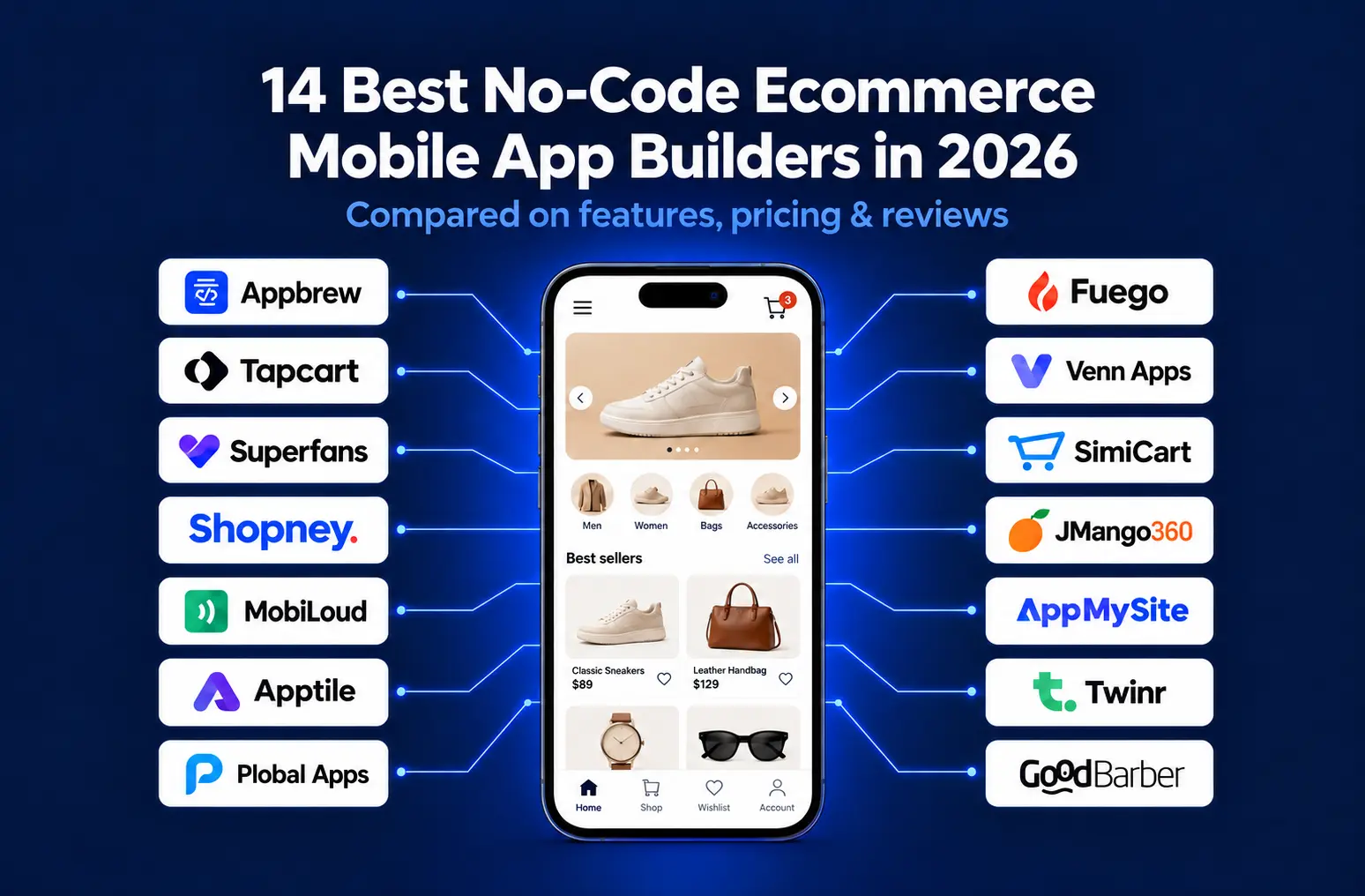
Compare 10 Fuego alternatives for Shopify by pricing, AI tools, customization, and fees. Find the right mobile app builder for your store in 2026.
|
Appbrew, Shopney, Tapcart, and Tapday are worth shortlisting if you want a Shopify mobile app with a lower starting subscription than Fuego. OneMobile offers a free plan, while MobiLoud and Venn Apps suit brands with different technical or service requirements. |
Fuego is a good mobile app builder for Shopify. Merchants praise its drag-and-drop editor, AI screen tools, and brands like True Classic and Kitsch run their apps on it. So why are so many Shopify brands searching for Fuego alternatives?
Usually it's the price. Starter now costs $999 a month, and the AI agent, segmentation and A/B testing sit on an Enterprise plan you can only price on a sales call. That's a fair price for some brands. But for most brands, though, the real question is simpler: do you need to pay Plus-level prices for an app that actually grows revenue?
This guide compares 10 Fuego alternatives by starting price, fee model, feature access, and store fit. Some cost less. Others offer a different way to build or manage your app.
TL;DR: the best Fuego alternative for your store
- Best overall for scaling Shopify and Shopify Plus brands: Appbrew. Native apps with Milo, an AI agent that builds your app, edits screens, launches push campaigns and reads your funnel from a single prompt. Included on every plan, from $199/month.
- Best value: Shopney at $149/month, with no commission on app sales and unlimited push notifications.
- Lowest monthly price: MageNative or Tapday, both around $99/month.
- Mature ecosystem for larger brands: Tapcart, from $500/month.
- Live selling and community: Vajro (now Superfans).
- Store not on Shopify, or headless: MobiLoud, from $1,499/month.
Quick Comparison: best Fuego alternatives for Shopify in 2026
To help you choose the right platform for your scale, here is a quick comparison of the top Fuego alternatives in 2026.
|
Platform |
Starting price |
Best for |
Key distinction vs. Fuego |
Rating |
|
$199/mo Starter; Pro $599, Enterprise custom |
Scaling Shopify and Shopify Plus brands that want AI to run the app |
Milo AI agent on every plan, where Fuego's is Enterprise-only; React Native apps and 120+ integrations |
5.0 (75+) |
|
|
Tapcart |
$500/mo Growth; AI add-on $250/mo |
Design-led brands with an in-house app team |
The biggest name in the category; segmentation and A/B testing need the $1,250 Scale plan |
4.7 (341) |
|
MobiLoud |
$1,499/mo + one-time build fee |
Stores not on Shopify, or headless builds |
Wraps your existing site instead of rebuilding it, and works beyond Shopify |
4.7 (109, Capterra) |
|
VennApps |
$1,999/mo Pro |
Brands that want a bespoke, fully managed app |
A dedicated designer and account manager instead of a self-serve builder |
5.0 (32) |
|
Plobal Apps |
$0/mo + 3% of app sales; Growth $199/mo |
Proving the app channel before paying a monthly fee |
No monthly fee to start, but a revenue share takes its place |
4.9 (134) |
|
OneMobile |
Free plan; ScaleUp $99/mo |
Launching with almost no upfront risk |
Publishable free plan; a per-order fee starts once app revenue passes $2,000/mo |
4.8 (365) |
|
MageNative |
$99/mo |
The lowest-cost native app |
A tenth of Fuego's entry price, with far shallower personalization |
4.8 (331) |
|
Tapday |
$99/mo |
Fast launches with no commission |
Flat tiers up to $599 with no revenue share, plus free migration from other builders |
5.0 (16) |
|
Shopney |
$149/mo |
Small to mid-size stores that want hands-on support |
In-app live chat and no commission; segmented push starts on the $599 plan |
5.0 (770) |
|
Superfans (formerly Vajro) |
$150/mo; Unlimited $1,000/mo |
Live selling, drops and loyalty |
Live selling built in; most standout features need the $1,000 plan, plus a success fee |
4.9 (878) |
Every builder also needs an Apple Developer account ($99/year) and a Google Play account ($25 one-time). Prices are verified as of October, 2026.
How much does Fuego cost in 2026?
Fuego Starter costs $999/month. Enterprise has custom pricing, and Fuego advertises no transaction fees or annual contracts.
|
Plan |
Monthly price |
Selected features |
|
Starter |
$999 |
Native iOS and Android apps, template blocks, unlimited screens and notifications, deep linking, analytics, and localization |
|
Enterprise |
Custom |
Audience segmentation, Apa AI agent, personalized push, A/B testing, custom React Native blocks, and additional enterprise features |
Starter costs $11,988 over 12 months before app store account fees or other services. If your strategy depends on Enterprise features, request that quote before comparing Fuego with another builder.
Why do Shopify brands look for a Fuego alternative in 2026?
The most useful reasons to compare alternatives are budget, feature access, operating workload, and technical fit.
1. The price has moved upmarket
Many of Fuego's five-star reviews date from 2023 and 2024, when merchants mention a free plan and praise its cost-effectiveness. Today Starter is $999/month, and Fuego positions itself for Shopify Plus and enterprise brands.
2. Features that move revenue are on Enterprise
The AI agent, audience segmentation, personalized push and A/B testing are all Enterprise-only, priced on a sales call. Starter buys you the app. Enterprise buys the tools that grow it.
3. Flexibility around integrations and tech stack
Fuego’s integration list is growing, but it is still limited to what their internal team has approved and built connectors for. If you run a complex tech stack, perhaps involving headless components, niche loyalty programs, or custom-coded features, you might find Fuego’s ecosystem too restrictive.
4. It assumes someone runs the app every week.
Without that person, the app turns into a static catalog. Newer builders let an AI agent make the changes instead.
5. Operational Simplicity and Support Expectations
Managing a Fuego app still requires significant internal bandwidth to configure layouts and manage template updates during campaigns. For lean teams, this is another tool to master and maintain.
Established Shopify brands often prefer "done-for-you" setups and white-glove support. Some Fuego competitors offer much faster time-to-market and ongoing strategic assistance, allowing you to focus on driving sales rather than troubleshooting app layouts or manually syncing your latest product drops.
The 10 best Fuego alternatives for Shopify in 2026
If Fuego’s limitations are holding you back, switching to a more capable platform can make a significant difference to your mobile strategy. Here are the top Fuego alternatives in 2026.
1. Appbrew: best overall Fuego alternative for scaling Shopify brands
Starting price: $199/month Starter, $599 Pro, with Enterprise priced on request. There's a 30-day free trial.
Best for: Shopify and Shopify Plus brands that treat the app as a revenue channel and want it to keep improving week after week, with AI handling the day-to-day operating work.
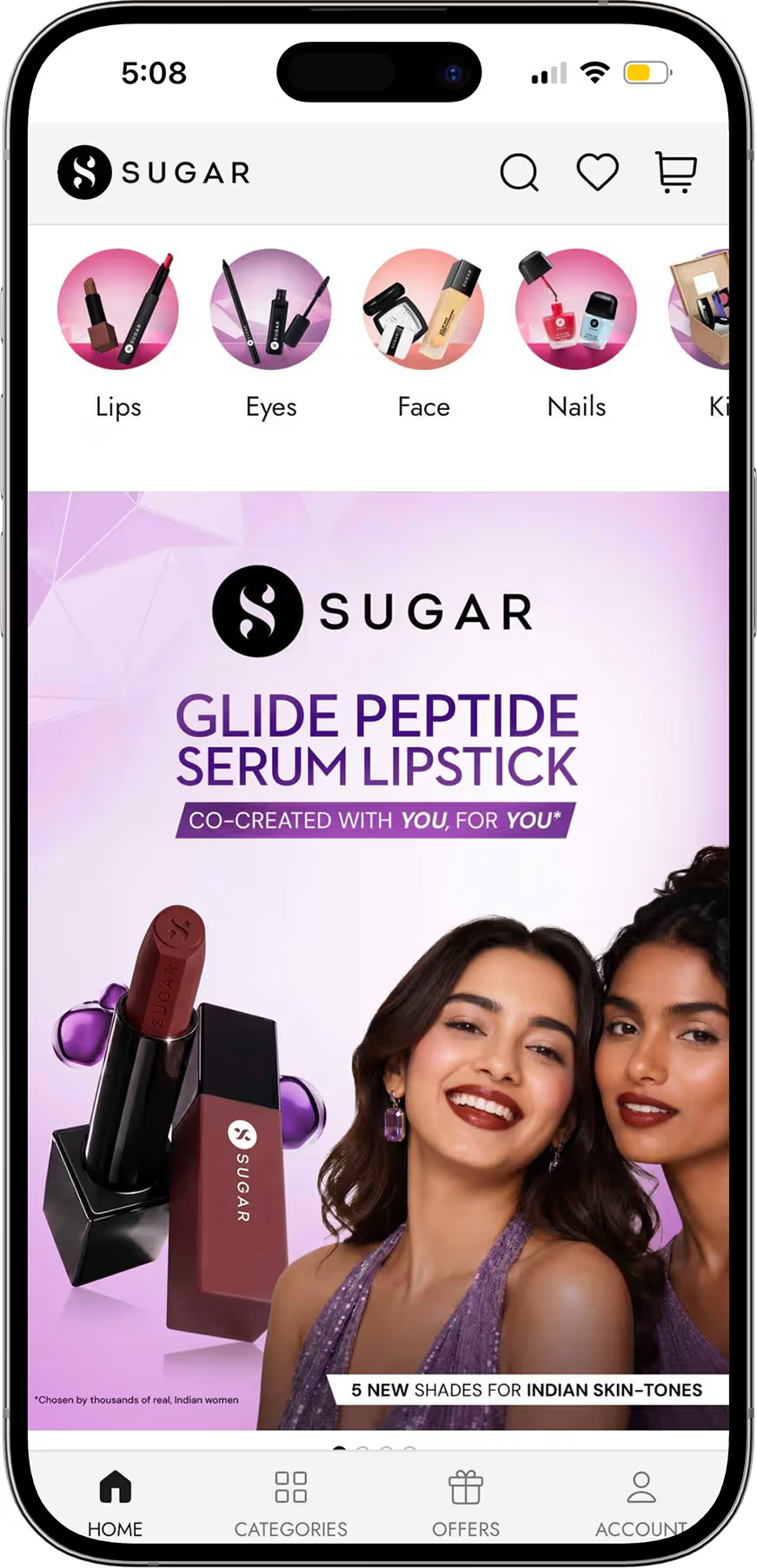
Appbrew turns your Shopify store into native iOS and Android apps with the help of an AI agent, Milo. Where Fuego gives you a powerful builder and expects a team to operate it, Appbrew lets a marketer describe a change and has Milo make it on the live app.
How it compares to Fuego: Most app builders, Fuego included, started as drag-and-drop tools and added AI on top. Appbrew is AI-native: the agent, Milo, is the core of the product rather than a feature layered onto it. The weekly work of keeping an app fresh and selling, the work that needs a dedicated operator on Fuego, takes a marketer a few prompts.
Where it shines vs. Fuego:
- A true AI agent on every plan, not an Enterprise extra. Fuego reserves its agent, Apa, for Enterprise. Milo comes with every Appbrew plan and is built as an agent with marketing judgment.
- Personalization without the upgrade. On Fuego, audience segmentation and personalized push only unlock on Enterprise. On Appbrew, Milo applies personalization rules and targeted campaigns on standard plans, so the app can show different shoppers different experiences from day one.
- Run it from Claude or ChatGPT. The Appbrew MCP (every plan) answers revenue and push questions, drafts themes and sends test pushes.
- AI that works for the shopper, too. Fuego's AI tools help you build the app. Appbrew's AI Concierge works inside it, as an in-app shopping assistant that gives each shopper personal product recommendations. It's live at brands like Minimalist and mCaffeine.
- Room to grow without lock-in. You get 120+ integrations against Fuego's 80+. Enterprise adds React Native code access, so your app is never trapped inside the builder.
Trade-offs: Appbrew is built for Shopify and Shopify plus only, so stores on other platforms should look at MobiLoud. Access to the app's source code is reserved for Enterprise, and the performance-based charges mean your bill grows as the app sells more.
Shopify App Store rating: 5.0 from 75+ reviews.
{{cta}}
2. Shopney: best-value Fuego alternative
Shopney gives you a native iOS and Android app with unlimited push notifications for $149 a month, with no commission on sales. If you're on Fuego mainly for a branded app and regular push campaigns, you'll get most of that here for a fraction of the cost.
Starting price: $149/month Silver, $299 Gold, $599 Platinum. No commission on app sales.
Best for: Small to mid-size stores that want a solid native app and responsive support for a fraction of Fuego's price.
How it compares to Fuego: Shopney costs about a seventh of Fuego's Starter plan and takes no cut of your sales. The trade is depth. Fuego's builder and community features go further, while Shopney focuses on getting a reliable app live quickly and keeping it running.
Where it shines vs. Fuego:
- Price-to-value: a full native app with unlimited push notifications from $149, against Fuego's $999 floor.
- Support reputation: a 5.0 rating across 770 reviews, many of them praising the setup and support team.
- In-app live chat: shoppers can message your team without leaving the app.
Trade-offs: Segmented and AI-driven push only arrive on the $599 Platinum plan. Design is more template-led than Fuego's builder, so highly custom layouts take more work. If those trade-offs rule it out, see these Shopney alternatives.
Shopify App Store rating: 5.0 from 770 reviews.
3. Tapcart: best for brands that want the category's most established platform
Tapcart builds native apps backed by one of the largest integration and agency ecosystems in the category, from $500 a month. If you want Fuego-level polish and a big partner network, and you have a team to run the app, it's a good choice.
Starting price: $500/month Growth, $1,250 Scale, $2,850 Enterprise+. Tapcart's AI features are a $250/month add-on.
Best for: Design-led brands with an in-house team that wants a mature platform and a large partner network.
How it compares to Fuego: Tapcart's entry plan costs half as much as Fuego's, but the comparison tightens as you add features. Segmentation and A/B testing need the $1,250 Scale plan, and AI costs extra on every tier. Fuego's Starter, by contrast, already includes unlimited screens and integrations.
Where it shines vs. Fuego:
- Ecosystem: the widest set of integrations and agencies familiar with the platform.
- Track record: years of large Shopify brands running revenue-driving apps on it.
- Transparent tiers: every plan price is published, unlike Fuego's call-only Enterprise tier.
Trade-offs: The features most brands want sit on Scale or above, and AI is billed separately. Some Fuego reviewers who switched from Tapcart said new features shipped too slowly for them.
Shopify App Store rating: 4.7 from 341 reviews.
4. Superfans (formerly Vajro): best for live selling and community commerce
Superfans builds native apps around live shopping, timed drops and loyalty, from $150 a month. If community features are what drew you to Fuego, this is the closest match, with live selling built into the product.
Starting price: $150/month Starter, $1,000/month Unlimited, plus a success fee.
Best for: Brands that sell through live video, limited drops or creator-led launches.
How it compares to Fuego: Both lean into community. Superfans goes further on live selling, which is built into the product rather than added through an integration. Its entry plan is far cheaper than Fuego's, but the standout features sit on the $1,000 Unlimited plan.
Where it shines vs. Fuego:
- Native live selling: shoppable live streams inside the app.
- Drops and loyalty: tools for timed launches and rewarding repeat buyers.
- Large review base: 4.9 stars across 878 reviews.
Trade-offs: Live selling and other headline features need the Unlimited plan, and the success fee grows with your app revenue.
Shopify App Store rating: 4.9 from 878 reviews.
5. Plobal Apps: best for launching with no monthly fee
Plobal Apps lets you publish a native app with no monthly fee and pay 3% of in-app sales instead. If you're not yet sure an app will earn back $999 a month, it lets you find out before committing to a fixed cost.
Starting price: $0/month plus 3% of in-app sales on Starter. Growth $199/month, Essential $499/month, and Enterprise $1,199/month plus 1%.
Best for: Stores that want to prove the app channel before committing to a fixed monthly cost.
How it compares to Fuego: It's the opposite pricing model. Fuego charges a flat $999 and takes no transaction fees. Plobal charges nothing upfront and takes a cut of each sale. At low app revenue Plobal is far cheaper. Once the app sells around $6,600 a month, 3% matches Plobal's own $199 Growth plan, so plan to switch tiers.
Where it shines vs. Fuego:
- Zero upfront cost: a live native app before you spend anything.
- A clear upgrade path: move to a flat plan once the app proves itself.
- Hands-on onboarding: a 4.9 rating driven largely by setup support.
Trade-offs: The revenue share makes the entry plan expensive as the app grows, and Enterprise keeps a 1% fee on top of the monthly price.
Shopify App Store rating: 4.9 from 134 reviews.
6. Tapday: best for flat pricing with no commission at any tier
Tapday offers native apps on four flat plans from $99 a month, with no commission on any of them. If you're leaving Fuego mainly to cut costs and want a predictable bill, it's the simplest move.
Starting price: $99/month Basic, $199 Standard, $399 Premium, $599 Enterprise, each with a 30-day free trial.
Best for: Value-focused brands that want predictable costs and a fast launch.
How it compares to Fuego: Tapday's top plan costs $400 less than Fuego's entry plan and includes custom blocks and automated drops. Its builder is less deep than Fuego's, and features unlock by tier through block limits, so the Basic plan is fairly restricted.
Where it shines vs. Fuego:
- No commission ever: every plan is flat, with no revenue share and no sales cap.
- Free migration: Tapday moves you over from your current builder at no cost.
- Low entry price: unlimited push notifications and analytics from $99.
Trade-offs: Basic caps you at 10 blocks. Abandoned cart and back-in-stock push need Standard, and removing Tapday branding needs Premium. With 16 reviews, it also has a much smaller track record than the leaders.
Shopify App Store rating: 5.0 from 16 reviews.
7. MageNative: best for the lowest-cost native app
MageNative gives you a native iOS and Android app from $99 a month, about a tenth of Fuego's entry price. If you need a solid branded app with push and don't plan to run heavy personalization, it covers the basics for the least money.
Starting price: $99/month, with higher tiers at $149 and $249.
Best for: Budget-conscious stores, and brands that also sell on Magento, WooCommerce or BigCommerce.
How it compares to Fuego: You save about $900 a month and keep a native app. You give up Fuego's builder depth, AI screen tools and community features. MageNative's app is more template-driven, which suits a catalog-and-checkout app better than a heavily merchandised one.
Where it shines vs. Fuego:
- Lowest monthly cost for a native app on this list.
- Works beyond Shopify: useful if you run stores on more than one platform.
- No success fees on any plan.
Trade-offs: Personalization and design control are much shallower than Fuego's, so the app is harder to make feel distinctly yours.
Shopify App Store rating: 4.8 from 331 reviews.
8. OneMobile: best for testing the app channel for free
OneMobile lets you publish a native app on a free plan and upgrade only when it starts selling. If you want to see real app revenue before paying anything, this is the lowest-commitment way to do it. If you outgrow the free plan, compare these OneMobile alternatives.
Starting price: Free plan, then ScaleUp at $99/month.
Best for: Early-stage stores testing whether customers will download and buy through an app.
How it compares to Fuego: It's the opposite end of the market. Fuego asks for $999 a month and a sales call before you start. OneMobile lets you install and launch on your own for free. The catch is a per-order infrastructure fee once your app passes $2,000 a month in revenue, so costs rise as the app succeeds.
Where it shines vs. Fuego:
- A publishable free plan: a live app with no monthly fee.
- Self-serve setup: no demo or sales process to get started.
- Affordable step up: $99/month when you need more.
Trade-offs: The per-order fee above $2,000 a month makes it more expensive as you grow, and the builder is far less capable than Fuego's for brands that want deep customization.
Shopify App Store rating: 4.8 from 365 reviews.
9. MobiLoud: best for stores not on Shopify, or headless builds
MobiLoud turns your existing website into an iOS and Android app, and its team builds and publishes the app for you. If you're on a custom or headless stack that Fuego and most Shopify builders can't support, it's the most practical route to an app.
Starting price: $1,499/month, plus a one-time build fee.
Best for: Brands on WooCommerce, Magento, BigCommerce, custom platforms or headless Shopify.
How it compares to Fuego: Fuego builds a native app from Shopify data. MobiLoud wraps the site you already have, so everything on your website, including custom features and checkout, carries into the app with no rebuild. That's an advantage for complex sites, but app screens load like web pages rather than native ones.
Where it shines vs. Fuego:
- Works on any platform, not just Shopify.
- Done for you: MobiLoud's team handles the build, publishing and updates.
- No duplicate work: changes to your website show up in the app automatically.
Trade-offs: It costs more than Fuego's Starter plan, adds overage charges as monthly active users grow, and a wrapped site won't feel as fast as a fully native app.
Capterra rating: 4.7 from 109 reviews.
10. VennApps: best for a bespoke, fully managed app
VennApps assigns a dedicated designer and account manager to build and run your native app, from $1,999 a month. If you'd rather hand the whole app to a team than operate a builder yourself, it's the white-glove option.
Starting price: $1,999/month Pro, with a higher tier at $2,999.
Best for: Larger brands that want a custom-designed app and an ongoing managed service.
How it compares to Fuego: Fuego gives you the builder and support to run the app yourself. VennApps runs it for you. You pay about twice Fuego's Starter price, but design, updates and campaigns are handled by people assigned to your account.
Where it shines vs. Fuego:
- Bespoke design: the app is designed around your brand rather than built from template blocks.
- A dedicated team: a named designer and account manager instead of a support queue.
- Fully managed: little ongoing work for your in-house team.
Trade-offs: It's the most expensive option here, and every change goes through VennApps' team rather than happening instantly in a builder.
Shopify App Store rating: 5.0 from 32 reviews.
How to choose the right Fuego alternative
Start with your required features and expected total cost. Then test how easily your team can operate the app.
1. Compare costs at your expected revenue
Include the subscription, revenue fees, usage charges, setup fees, and paid add-ons. Calculate the bill at today's app revenue and at the revenue you expect in 12 months.
A low subscription can still be expensive at scale. A higher subscription can be reasonable if the app generates enough incremental profit to cover it.
2. Test the workflows your team will use
Ask each shortlisted provider to demonstrate the same tasks: launch a collection, create a promotion, send a targeted push campaign, and review campaign results.
For AI tools, check what they can execute, what needs approval, and what the selected plan includes. A content generator and an assistant that can change app layouts solve different problems.
3. Confirm your integrations on the selected plan
Check your actual loyalty, reviews, subscriptions, search, and analytics tools. Integration counts alone do not show whether your required workflow is supported.
For example, a subscription integration should support the customer actions you need inside the app. A logo on an integrations page does not explain that scope.
4. Check ownership and migration terms
Ask who owns the app listings, what you can export, and how a future migration works. Include push subscribers, deep links, analytics, and custom features in that discussion.
How to migrate from Fuego without losing your app users
A migration can preserve your existing listings if the replacement is published as an update to the same app. Confirm the technical requirements first.
1. Confirm access to the developer accounts
Identify who owns the Apple and Google accounts and who can submit updates. Ask the providers to confirm app identifiers, signing requirements, and any necessary account transfers.
2. Build and test the replacement
Keep the existing app available while the new version is prepared. Test product data, customer accounts, checkout, subscriptions, loyalty, and analytics before submission.
3. Plan push and deep-link continuity
Ask how notification permissions, push tokens, and campaign data will be handled. Test URLs from email, SMS, ads, QR codes, and saved links against the replacement app.
4. Publish the update and monitor performance
Review crashes, checkout completion, push delivery, and analytics after release. Customers may need to update before they use the new version.
5. End the old subscription after the transition
Confirm the replacement is stable, required data is retained, and outstanding obligations are resolved before ending the Fuego subscription. Get a migration timeline from the new provider based on your app's scope.
With Appbrew, the team handles the rebuild and publishing alongside you, and Milo can recreate screens and campaigns from a prompt. Most brands moving to Appbrew from another builder go live in 1–3 weeks.
FFS Beauty relaunched within weeks of leaving Tapcart and doubled its app conversion rate, and Dermaclara saw a 32% higher app conversion rate after making the same switch.
How we compared these builders
Each builder was compared on five things that matter to a brand weighing Fuego:
- starting price
- fee model
- which plan unlocks AI and audience segmentation
- Shopify App Store rating
- the kind of brand it fits best
Prices were checked on vendor pricing pages and Shopify App Store listings on October 8, 2026. Ratings come from live Shopify App Store listings unless noted. For a wider view beyond Fuego, here's everything you need to know about the best Shopify mobile app builders.
See how Appbrew compares on your own store
The quickest way to compare is to see your own app running on Appbrew. Start a 30-day free trial, or book a demo and we'll show you three things: what Milo can do with your store, what you'd pay at your current app revenue, and how a move from Fuego would work. Start your free trial.
{{cta2}}
FAQs
Is there a cheaper alternative to Fuego?
Yes. Tapday and MageNative start at $99/month, Shopney at $149, and Appbrew at $199, compared with Fuego Starter at $999. A lower entry subscription does not necessarily include the same tools or remain cheaper as app revenue grows.
Is there an alternative to Fuego for Shopify?
Yes. The main alternatives to Fuego for building a native iOS and Android app from a Shopify store are Appbrew, Shopney, Tapcart, Superfans (formerly Vajro), Plobal Apps, Tapday, MageNative, OneMobile, MobiLoud, and VennApps. They differ most on price, fee model and how much of the app you can customize.
Which Fuego alternatives don't charge a commission on sales?
Shopney, Tapday and MageNative charge a flat monthly fee with no commission. Plobal's free Starter plan takes 3% of in-app sales. OneMobile adds a per-order fee once app revenue passes $2,000 a month. Superfans adds a success fee, and AppBrew's plans include performance-based charges. Fuego itself charges no transaction fees.
Which Fuego alternative includes an AI agent?
Appbrew includes Milo, an AI agent that updates your app, launches push campaigns and reports on performance from a prompt, on every plan from $199/month. Fuego's AI agent is on its custom-priced Enterprise plan. Tapcart sells its AI features as a $250/month add-on.
Can I switch from Fuego without losing my app users?
Yes, as long as the new app ships as an update to your existing App Store and Google Play listings. Customers update rather than reinstall, and your ratings and reviews stay in place. Confirm that your developer accounts are in your business's name, and get your Android signing key from Fuego before you start. Migrations to Appbrew typically take 3–4 weeks.
Are Fuego alternatives native apps or web wrappers?
Most builders on this list, including Appbrew, Tapcart and Shopney, build native apps, as Fuego does. MobiLoud is the main exception. It wraps your existing website into an app, which suits stores that aren't on Shopify but won't feel as fast as a native app.
Do I need Apple and Google developer accounts?
Yes. Apps publish under your own accounts. An Apple Developer account costs $99 a year, and a Google Play developer account is a $25 one-time fee.
Is Fuego worth $999 a month?
It can be for a Shopify Plus brand with an in-house team shipping app updates every week, where the app is already a major revenue channel. At $5,000 a month in app revenue, Fuego Starter costs about 20% of what the app earns. At $50,000 it's 2%. If your app is still growing toward that scale, a lower-cost builder usually pays back sooner.
Review your current app revenue, feature requirements, expected Appbrew cost, and migration process with a mobile app expert.